
Surgical Coverage Intelligence
Presago · to know beforehand
Get paid for the surgery
you did right.
Presago prevents the denial before it happens, at the point of care. We tell you what each insurer requires to cover a procedure before you operate, and then make sure your records match those rules.
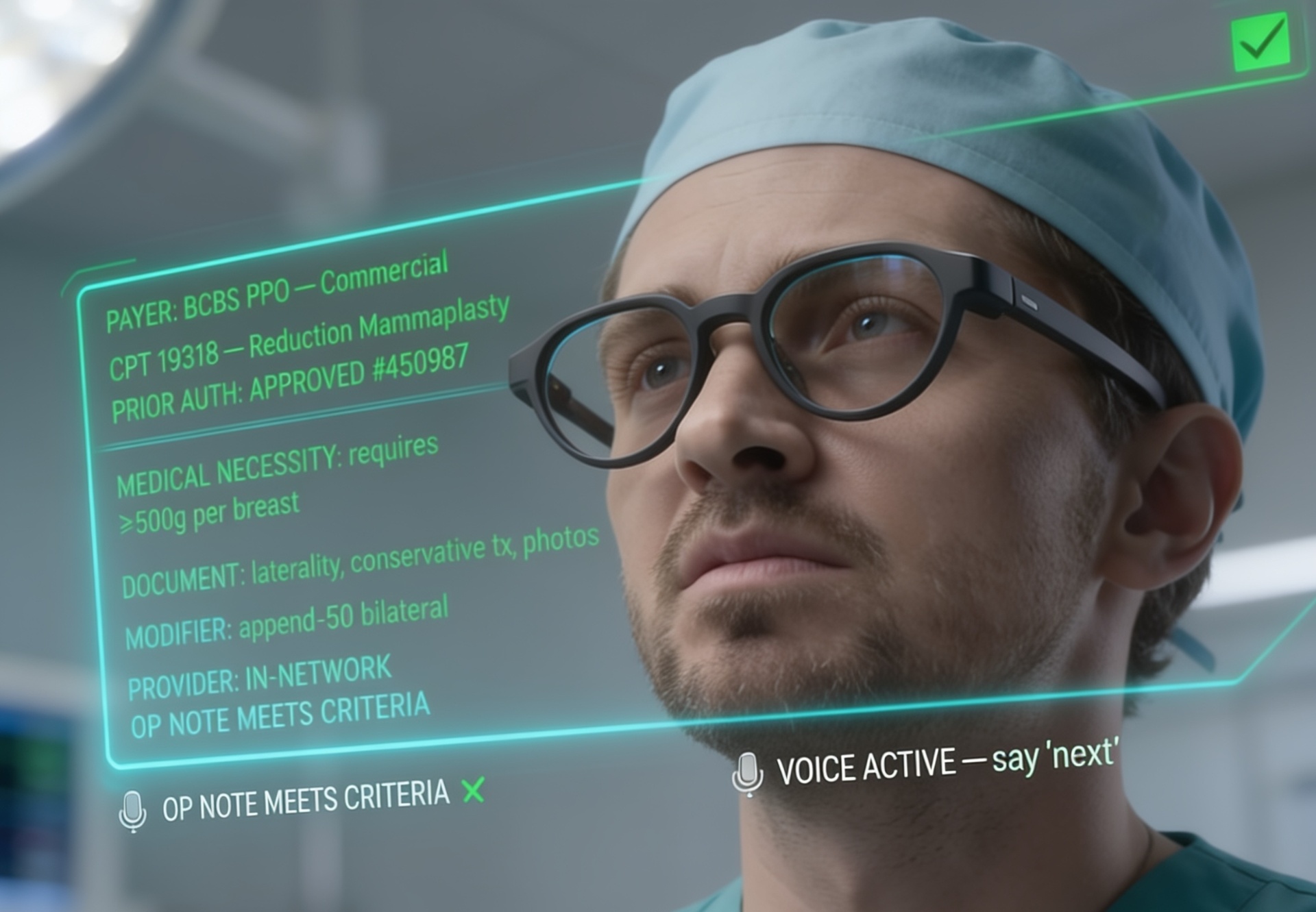
Presago is always on call at the surgeon's eye line. Hands-free glasses prompt the surgeon on what to document.
Same surgery. Same patient. A different answer at every insurer.
Every carrier sets its own medical-necessity criteria, and the rules shift monthly. Surgeons write off revenue on cases they performed correctly, because the note did not match one payer's specific criteria.
- ~21%
- of commercial surgical claims are denied on first pass.
- <10%
- of winnable denials are ever appealed. Most revenue is simply written off.
The math behind the write-offs.
The denial problem is not a billing problem. It is a documentation problem, solved a floor away from where it starts.
- $18B
- spent every year fighting legitimate denials that should have been paid.
- >50%
- of denial appeals win, but fewer than 10% are ever filed.
- ~66%
- of breast-reduction denials had already been pre-approved. Approval is not payment.
- ~4 hrs
- of paperwork returned to each surgeon every week.
Know before you cut. Capture in the field. Bill clean.
One coverage layer, delivered in three moments. It is the only one that reaches the surgeon at the point of care, not the biller after the fact.
- 01
Before the case
Enter the procedure and payer. Presago flags likely denials against that carrier's current criteria, with source links.
- 02
In the OR
Camera-free smart glasses cue the exact clinical facts to document. Hands-free, voice-driven, without breaking scrub.
- 03
After
An AI-drafted operative note, auto-formatted to satisfy that payer's medical-necessity criteria the first time.
One procedure, four answers
Take a breast reduction.
Most payers only cover it if a minimum amount of tissue is removed. The threshold is different at every carrier, and the rules shift constantly. The surgeon almost never knows the specific number at the moment they document.
65.8% of breast-reduction denials had already received prior authorization. Approval is not payment. The op note is re-judged against criteria at claim time.
- UnitedHealthcare~500 g / breast floor
- Cigna / Anthem>1,000 g, or Schnur scale
- AetnaOwn table + stricter symptom gate
- Medicaid (varies)Sometimes no gram threshold
The obvious question
"Doesn't Epic do this?"
Epic owns the note. It does not own the coverage rules.
Epic handles documentation and dictation. It does not maintain each commercial payer's medical-necessity criteria, and it does not warn the surgeon while they document. That intelligence lives outside Epic, sold to back-office review teams, never surfaced to the person holding the scalpel.
Presago sits in the surgeon's eye line, not the billing queue. That is the gap, and it is why CMS 0057 mandating machine-readable payer coverage data by January 1, 2027 makes this the moment to solve it.
For the surgeon
- — No coverage guesswork mid-case.
- — About four hours of paperwork off your plate each week.
- — Fewer denials on cases you did correctly.
For the practice
- — Revenue protected on cases already performed.
- — Less prior-auth labor and appeal rework.
- — Cleaner first-pass claims across every carrier.
Pricing, plainly.
Two tiers, per surgeon. No seats, no setup fees.
Coverage Engine
- Pre-op payer coverage checks
- Payer-specific criteria with source links
- HIPAA-free, no PHI required
Full Platform
- Everything in Coverage Engine, plus:
- In-OR hands-free capture on smart glasses
- Auto-drafted op notes formatted to payer criteria
- Fewer appeals, cleaner first-pass claims
~$65,000 of revenue returned per surgeon per year. Full Platform pays for itself at roughly one saved case per month.
HIPAA by design. Built on licensed AMA CPT data and public payer policy. Reminders only. Never clinical advice.
Sources: Kodiak 2024; Premier 2023; KFF 2024; PRS Global Open (Boyd et al., Auctus Group data, 2022).
Talk to the team building it.
Walk through how Presago works, share the carriers and procedures hitting your practice hardest, and help shape what gets built next.
Book a callconnect@originnodegroup.com
Surgeons are shaping what Presago becomes.
The earliest surgeons on Presago help set what we build next. If you want to help decide the future of Presago, let's talk.
Founding surgeon interest